Almost 95% of internet users are now on social media. It’s safe to say that if you wish to know something about your target audience, social media is the first place you should look.
Investing in social media intelligence is much more effective than running surveys or polls because your customers can say what they *really* mean. (And we’re not just saying this; there are scientific studies that prove this theory.)
💡 Read Sentiment Analysis 101: Everything You Need to Know
In today’s day and age, where the marketing industry is ripe with artificial intelligence, conducting social media sentiment analysis is easier than ever. You have all the information at your fingertips to help you make data-driven decisions.
On that note, here are the top 7 social media sentiment analysis tools you should check out to gather public opinion and actionable insights. We’ve covered the key features each solution offers, alongside pricing information and customer reviews.
Let’s dig in!
What Are Social Media Sentiment Analysis Tools?
A social media analysis tool helps companies find out what people are saying about them on social media platforms like Facebook, Twitter, Instagram, and TikTok.
These tools use machine learning and artificial intelligence (AI) to collect brand mentions and give you a clear picture of your company’s social media virality, negative sentiments, and sentiment score.

Many companies, from small businesses to large corporations, rely on social media sentiment analysis tools to:
- See how your brand’s social media posts are performing on your social media platforms
- Review positive and negative sentiments
- Compare brand mentions to competitors
- Partner with influencers who enjoy their products or services
If you want to find out how much of a difference your company is making in the lives of your target audience, you should invest in a social media sentiment analysis tool.
Why Should You Use A Social Media Sentiment Analysis Tool?
There are many different reasons social media sentiment analysis is important. These reasons include:
Sentiment Analysis Provides Essential Campaign Insights
Social media analysis isn’t just about likes, shares, and comments. These tools provide more qualitative data, meaning you can find out why certain posts perform better than others.

With a social media analysis tool, you can see posts that your target audience is sharing the most (and what they are saying about it).
The frequency of posts affects the volume and diversity of data available for sentiment analysis. More posts generate a larger dataset, providing a comprehensive view of audience sentiment over time.
This wealth of data lets your brand spot subtle sentiment shifts and identify evolving trends. By staying attuned to these trends, you can adapt their content strategy to remain relevant and engaging in a dynamic social media landscape.
For companies aiming to enhance their social media sentiment analysis efforts, scheduling posts on Instagram and other platforms is indispensable. It allows them to strategically time content releases, guaranteeing that sentiment analysis captures the full spectrum of audience responses.
You Can See How People Really Feel About Your Brand
Learning how your customers really feel about your brand is the most valuable information you can get. It can help you create more refined products, brand messaging, and marketing strategies.

On top of that, you can get a feel of what your company’s customer journey really looks like. In this way, sentiment analysis doesn’t just provide insight into the numbers you’re generating on social media and the reasons that are driving them.
Sentiment Analysis Improves Customer Service
Social media platforms are being increasingly used for customer service. It’s not uncommon for people to take their frustrations to a brand on social media and hear back through a response or direct message.
As a result, social media sentiment analysis makes it possible to gauge your customer service performance. For example, you can scan through brand mentions to review:
- Response times
- First contact resolution times
- Average handle time
- Customer satisfaction

For example, you can set up trigger notifications to catch any negative coverage or comments as soon as they’re published online. That way, you can put out fires before they spread.
You Can Easily Spot Trends and Patterns
By analyzing what others say about your brand, you can spot trends and patterns through similar brand mentions and user behavior.
This benefit can help you achieve higher ROI from your brand strategy and make more strategic business decisions. It’s also important to point out that only 43% of companies have a central location for cross-platform analytics.
That means not many companies can compile all their social media data in one platform, especially using different social media channels. Social media monitoring tools make it possible.
Key Features To Look For In A Social Media Sentiment Analysis Tool
Not all social media tools are created equal. If you’re on the hunt for quality sentiment analysis software, here are some considerations to make:
Data Management
Before settling on any option, you should research extensively where the tool derives its data. Why? Quality data means everything.
Generally, social media analysis tools collect the following types of data:
- Geographic coverage
- Media coverage
- Language coverage
- Industry-specific coverage
You should also be mindful of how the tool delivers data alerts about positive sentiment. For example, do you want to receive alerts based on specific keywords or if your social mentions reach a certain number?
Oh, and does the tool have plenty of APIs and integrations you can use to centralize and export your data? The goal is to reduce the number of tools in your tech stack to reduce bottlenecks (read: the right integrations are crucial).
Data Analysis
You shouldn’t only be concerned about where you’re getting your data from. You should also consider how a tool gives you the power to curate your data.
For example, what kinds of data and valuable insights will the tool allow you to collect? Will you be able to view metrics specific to each social media profile? Can you review category metrics, such as social listening and total exposure metrics?
Also, are there any filtering or sorting capabilities? The best social media sentiment analysis tools allow users to create their own filters to search for keywords across different social channels.
Filtering and segmenting this data is extremely important if you want to gain a clearer picture of how popular your brand is on social media. What are people really saying about your brand online?
Read What Is Media Analysis And Why Does It Matter

A high-quality sentiment analysis tool gives a great deal of customization to agencies, companies, and brands to gain complete coverage over their online reputations. That way, you can track the most important keywords, hashtags, and phrases to your brand.
How Does A Social Media Sentiment Analysis Tool Work?
Social media sentiment analysis tools rely on AI, natural language processing, and machine learning to process huge amounts of data and find patterns and trends.
For example, let’s say Domino’s Pizza wants to find specific brand mentions and customer sentiment after releasing a new pizza topped with peaches (instead of pineapple).
When you create a keyword (or filter), the sentiment analysis tool will use AI to find any mention of the keyword on multiple social media platforms.

Through machine learning, the tool can create algorithms to create reports based on this data. Machine learning also enables these tools to categorize specific sentiments and actionable insights.
In this case, 61% of mentions were negative about peaches on pizza, and only 39% were positive. It’s safe to say that consumers don’t love this new pizza. So, it’s back to the drawing board for Domino’s Pizza.
Top 7 Best Social Media Sentiment Analysis Tools
1. Determ

Determ is an advanced social media monitoring platform tailored specifically for PR and marketing professionals. It empowers teams to monitor social mentions, proactively manage crises, and gain a deeper understanding of customer sentiment across platforms—all from a single, easy-to-use dashboard. With Determ, you’ll have the tools you need to build stronger campaigns, protect your brand reputation, and stay ahead of the competition.
Key Features:
- It tracks all types of sentiments (negative, positive, neutral, etc.) over a period of time to find what changed and what works. Determ provides detailed, time-sensitive analysis, so you can track shifts in customer sentiment over hours, days, or weeks.
- It provides real-time alerts if it sees any spikes in audience sentiments so you can address issues immediately.
- You can use its AI capabilities to summarize audience sentiments, analyze data patterns, and gather valuable insights. Determ will also detect which keywords, phrases and emojis were most often used in your interactions.
- It can create advanced reports that track your public opinion across different social media channels (and web) over a period of time. You can also cross-compare this data with those of your competitors.
Pricing: There are three different subscription plans: Plus, Premium, and Multi-Brand. Book a demo to find out more about the pricing pans.
User Reviews: Rated 4.7/5 on G2.
2. Brand24

Like Determ, Brand24 is a platform created for marketers and PR professionals. It allows them to keep track of mentions, analyze sentiments and feedback, and create comprehensive reports.
However, one of the primary differences is Determ is a media monitoring tool, while Brand24 is a social listening tool.
Key Features:
- Same as Determ, Brand24 tracks positive sentiments, negative sentiments, and neutral sentiments over time (days/weeks/months) and across various social media platforms and information sources (review sites, blogs, podcasts, news sites, etc.).
- It uses a sentiment analysis model that analyzes emojis, mentions, UGC, emotions, etc., considers context, and finds intent. It then classifies all of this information with the help of a sentiment score.
- It supports a wide range of languages to gather public sentiments. It will also create detailed reports to ship off all this information to you.
Pricing: Four pricing options are available: Individual ($119/month), Team ($159/month), Pro ($239/month), and Enterprise ($399/month).
User Reviews: Rated 4.6/5 on G2.
3. Sprout Social

Sprout Social is a tools that helps manage your social media presence. Amongst one of its capabilities is social media sentiment analysis. We look at some of its key features below:
Key Features:
- It provides a sentiment score by predicting the “probabilities” of the word(s) used in any interaction. For example, if a word like “loved” or “liked” pops up, it classifies it as a positive sentiment.
- Like other solutions on the list, it can track sentiments over time and across various online sources (e.g., social media posts, reviews, news sources, etc.).
- You can use its social listening capabilities to conduct competitor and marketing campaign analysis, gather industry insights, find your brand “health” — aka, your reputation, and access information about your demographic, conversation themes, sentiment trends, etc.
Pricing: Four pricing options are available — Standard ($199/seat/month), Professional ($299/seat/month), Advanced ($399/seat/month), and Enterprise (custom quote).
User Reviews: Rated 4.4/5 on G2.
4. Meltwater

Developed in 2001, Meltwater is one of the industry’s oldest solutions for social media analysis.
It can not only keep track of social media mentions, but it can also help with market research, identify key journalists and influencers in your space, and provide sales intelligence to boost revenue.
Key Features:
- It provides audience sentiments over time and across social media platforms. It also allows you to classify negative and positive sentiments separately to find overarching patterns.
- It uses NLP (natural language processing), machine learning, and sentiment models to find relevant words, context, and intent of any audience interaction.
- You can change any sentiment of the data sources it provides. For example, if it classifies the sentiment of a news article as “positive,” you can change it to “negative” or “neutral.” You can do this individually or in bulk.
Pricing: Three product packages are available — Essentials, Suite, and Enterprise. You’ll need to get in touch with the sales team to get a custom quote.
User Reviews: Rated 4/5 on G2.
5. Statusbrew

Statusbrew is one of the best solutions for small and mid-sized businesses due to its affordable price point and impressive feature set. In the area of social sentiment analysis, here’s what it has to offer:
Key Features:
- It can support multiple languages and identify the patterns within them to classify any interaction as positive, negative, or neutral. Same as Meltwater, you can change the sentiment of any interaction if you think it does not fit the bill (e.g., positive to negative).
- It has advanced filtering options through which you can categorize each sentiment. You can also use its filters to divvy up your conversations based on language, keywords, user role, conversation type, profile group, activity, etc.
- You can create reports to find valuable insights, such as total brand sentiments over a period of time and changes in engagement levels.
Pricing: Four pricing options are available — Lite ($69/month), Standard ($129/month), Premium ($229/month), and Enterprise (custom quote).
User Reviews: Rated 4.7/5 on G2.
6. Idiomatic

Idiomatic prides itself on being a customer-focused company. This is not a philosophy that applies only to its own customers but also to its customer’s customers. That’s to say, if you’re an Idiomatic user, it’ll provide you with all the customer feedback you need to improve the end user’s experience.
Key Features:
- In addition to social media channels, it uses other sources, such as feedback forms, surveys, support tickets, emails, chatbox messages, etc. These help analyze overall audience sentiment and provide a sentiment score.
- Instead of using general NLP (natural language processing) models, it’s taken the time to create its own training data and mix it with machine learning algorithms to provide accurate and contextual insights.
- Like other solutions on this list, it can track negative, positive, and neutral sentiments over a period of time. You can filter your insights through keywords, categories, or customer segments.
Pricing: Three subscription options are available — “Solo” (billed at $199/month), whereas “Team” and “Business” require custom quotes.
User Reviews: Rated 4.6/5 on G2.
7. Talkwalker

Powered by Hootsuite, a social media management tool, Talkwalker is a solution specifically designed for breaking down social media analytics, including audience sentiments, social benchmarks, content ratings, media mentions, customer feedback, etc.
Key Features:
- Like Idiomatic, you can find customer sentiments on Talkwalker through the help of various sources, such as tickets, emails, surveys, reviews, alongside social media posts.
- It uses AI to prioritize mentions and understand context and nuance. (For reference, Talkwalker can understand sarcasm, slang, irony, etc., across 127+ languages with a 90% accuracy rate.)
- With it, you can track your net sentiments over a period of time, measure and contrast your performance against competitors, and even find influencers that talk about your brand in a positive light.
Pricing: Four pricing options are available — Listen, Analyze, Business, and Premium. You’ll need to contact the sales team to get pricing information on them.
User Reviews: Rated 4.3/5 on G2.
After reviewing these leading tools, it’s worth noting how brands are expanding their marketing channels. Many are now using QR codes on their marketing materials, product packaging, and in-store displays to connect with customers both online and offline.
This blend of digital and physical interactions makes picking the right social media sentiment analysis tool even more important for getting the full picture of your customer experience.
Which Solution Does Your Organization Need?
We might go on a hunch here and say that if you’re on this page, you’re in the market to shop for a social media sentiment analysis tool and are browsing your options.
While we cannot deny all these tools have an impressive feature list and some great customer reviews, we’d implore you to stick with an option that:
- Has an easy learning curve;
- Has gathered excellent ratings from review sites
- Can get the job done.
To make a case for Determ, we can assure you of the following:
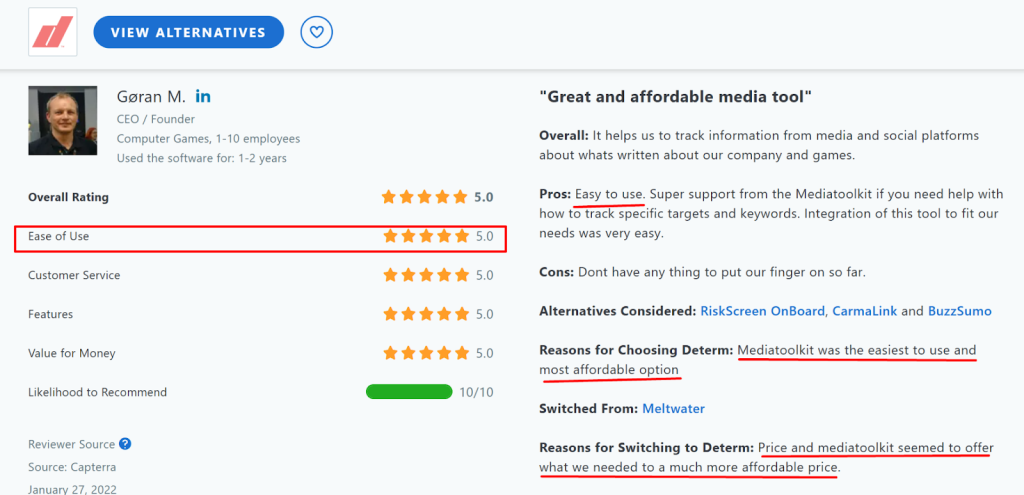
#1: Our customers have repeatedly mentioned our ease of use and affordable price point in comparison to the other solutions. For reference:
#2: We have impressive ratings across the board. (We’re rated 4.7/5 on G2, 4.8/5 on Featured Customers, 4.4/5 on Capterra.)
#3: We have impressive media monitoring software and API that can track your audience sentiments (and much more!) in real time. Brands like WWF, Al Jazeera, Uber, and McCANN trust our insights to make data-driven decisions.
So, if you want to know how Determ can help your brand specifically, book a free demo and get your questions answered by our experts!
Author Bio Juwaria is a freelance writer specializing in the fields of SaaS, marketing, and health/wellness. Backed with 3+ years of experience, she helps brands build content that adds value to their business. In her free time, you can catch her reading her favorite books or studying the latest trends online.


