61% of businesses use sentiment analysis tools to understand customer emotions and preferences. Investing in these types of tools is key, especially when 66% of customers want brands to understand their specific needs and expectations.
💡 Read Sentiment Analysis 101: Everything You Need to Know
Being able to analyze customer feedback, social media posts, product reviews, and more on a large scale allows companies to make data-driven decisions—at a much faster rate than what’s possible with manual analysis.
With a wide range of sentiment analysis solutions available, it’s important to look at different factors like accuracy, customization, and integration capabilities.
To make your search easier, this guide explores some of the most effective tools. Here, we’ll highlight their features, strengths, and ideal use cases.
Let’s dive right in.
What Is a Sentiment Analysis Tool?
A sentiment analysis tool is a software application or platform that uses natural language processing (NLP), machine learning, and text analysis techniques to determine the emotional tone behind what people write.
These tools analyze words, phrases, and context, which allows them to classify text as positive, negative, or neutral.
Then, they assign sentiment scores and categorize results by sentiment.
Some tools even identify more nuanced emotions like anger, joy, or sadness.
Sentiment analysis tools can be extremely helpful in the following ways:
- Evaluating customer feedback
- Monitoring brand perception
- Analyzing social media sentiment
- Gaining actionable insights into public opinion
A platform for monitoring employees can complement sentiment analysis tools by giving you a clearer picture of team morale. These platforms help track engagement trends across your workforce, offering real-time insights to identify when and where employees might feel disengaged or overworked. When paired with sentiment analysis, you gain actionable insights to proactively address concerns and create a healthier work environment.
What to Look for in a Sentiment Analysis Tool
When choosing a sentiment analysis tool, make sure you’re evaluating its features against your needs. Here are key factors to consider.
- Speed and scale: Your tool of choice should be able to handle large volumes of data quickly. This is important if you’re handling big datasets like customer reviews or social media posts. Some tools are even fast enough to analyze real-time data, so you can respond immediately to trends or negative feedback.
- Accuracy: Look for a solution that can correctly identify whether the text is positive, negative, or neutral. A good tool should also handle tricky situations like sarcasm, mixed emotions, or ambiguous language.
- Social media platform integration: To monitor brand perception or customer sentiment, make sure your tool connects seamlessly with social platforms. This will allow you to capture and analyze posts, comments, hashtags, and trends.
- Aspect-based analysis: This feature breaks down feedback into specific parts or “aspects.” For example, instead of just saying a review had a positive sentiment, the tool might tell you the customer loved the price but wasn’t happy with the delivery time.
- Language support: If your audience speaks multiple languages, the sentiment analysis tool should be able to analyze text in all those languages. This ensures accurate results, no matter where your customers are from.
- Entity extraction: Entity extraction identifies specific names, places, or brands that occur in the text. For example, it can tell you if someone is talking about your company, a competitor, or a product.
- Reporting dashboard: A good tool will present results in a clear, visual way with detailed reports. Dashboards with charts and graphs make it easy to understand patterns and trends without needing to sort through raw data.
- Customization: Customization lets you adjust the tool to fit your needs. For instance, you can teach it industry-specific terms or decide what counts as positive or negative in your context.
Best Sentiment Analysis Software
Here’s an overview of some of the best sentiment analysis software available today. We’ll discuss their key features, use cases, and what makes them stand out.
Determ
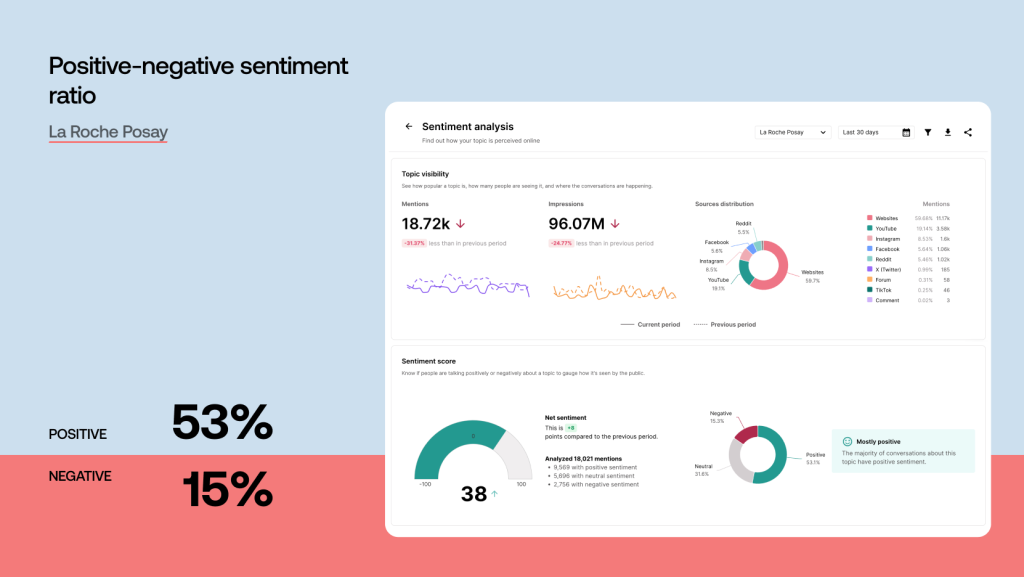
Determ specializes in real-time media monitoring and sentiment analysis using natural language processing. It tracks mentions of your brand, products, or industry across 100+ million sources daily. This includes websites, news sites, forums, blogs, social media platforms, and even comment sections.
As a result, you get valuable insights into how people perceive your business, even when they don’t tag your company’s handle.
In sentiment analysis, there’s a strong emphasis on the phrase “real-time”. This is one area where Determ excels. The platform can process large volumes of online chatter instantly and send you alerts for emerging trends or crises.

You can set up alerts for specific keywords or sentiment shifts so you can act quickly.
Determ also offers powerful customization features. With Boolean operators, you can refine your search to ensure relevance. This allows you to add context to your keywords or exclude irrelevant mentions to focus only on what matters to your brand.
Plus, you get access to powerful filtering options. You can refine your results by different categories, such as language, location, influencer score, and sentiment score.
And we saved perhaps the best feature for last. Synthia, Determ’s PR AI assistant, simplifies public relations tasks by helping you save time and maximize efficiency. Synthia can quickly distill large volumes of data into clear, concise summaries. Beyond that, it offers actionable recommendations.
So, once it identifies potential opportunities, such as emerging trends or PR risks, it suggests strategies to address them. This saves you time on manual strategizing.
These features alone make Determ the ultimate choice for businesses that prioritize real-time actionable insights and need a tool that adapts to their needs, whether it’s managing PR crises, monitoring marketing campaigns, or improving customer experience.
Brand24

Brand24 focuses on social media and online mentions (e.g., news outlets, social networks, etc.) with sentiment analysis capabilities that help businesses manage their online reputation and refine marketing strategies.
It includes tools for tracking hashtags, competitor performance, and customer feedback.
Brand24’s dashboard visualizes this data, which helps you pinpoint where people are talking about your brand and how they feel.
The tool integrates with platforms like X, Instagram, YouTube, TikTok, Facebook, and more to give you a complete picture of your online reputation. Its focus on competitor tracking also allows you to benchmark your performance against others in the industry.
Brand24 goes a step beyond typical sentiment analysis solutions that just detect positive, neutral, or negative sentiments. The tool’s AI can detect human emotions like anger, admiration, disgust, fear, joy, and sadness.
Qualtrics
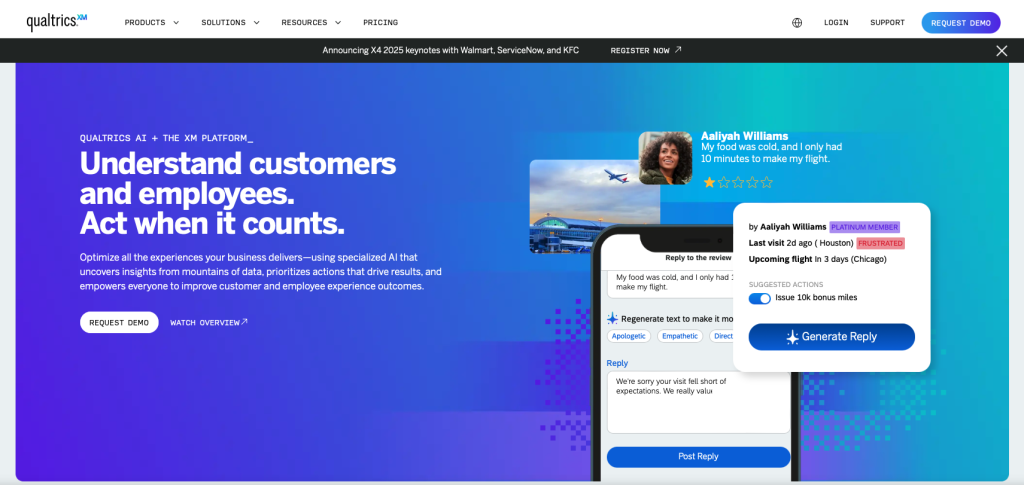
Qualitrics is a survey-based platform that uses sentiment analysis to make sense of open-ended feedback. With its sentiment analysis model Text iQ, you can measure emotions in customer surveys, employee feedback forms, and other written responses.
You’ll get the advanced context that groups feedback into interrelated topics. This allows you to spot common patterns and trends.
What sets Qualtrics apart is its integration with other experience metrics like Net Promoter Scores (NPS), customer satisfaction, or employee engagement data.
Qualtrics can be a great option if your focus is on enhancing customer experience or employee engagement.
Sprout Social

Sprout Social combines social media management with sentiment analysis in one platform. It’s a tool that lets you schedule posts, track engagement, and analyze public sentiment all in one place.
So, it can be invaluable if you need to monitor multiple accounts across different social platforms.
Another feature that Sprout Social has to offer is a feature called Sentiment Reclassification. Sometimes sentiment analysis tools can assign the wrong sentiment to a text. When this happens, it can cause inaccurate results.
With Sprout Social’s Sentiment Reclassification feature, you can manually change the sentiment classification if the tool classified it inaccurately.
And you can predefine a set of rules to increase accuracy and reduce the chances of wrong classification happening in the first place.
Medallia

Medallia is a highly customizable sentiment analysis platform powered by artificial intelligence. It allows you to build and train your own models for analyzing text data, such as online reviews, emails, or survey responses. So, you don’t have to rely on prebuilt sentiment categories.
The flexibility of Medallia makes it favorable for companies with unique or industry-specific needs.
This could include customer service teams analyzing tickets, product managers reviewing feedback, or researchers exploring unique datasets.
Like Qualtrics, Medallia lets you analyze Net Promoter Score (NPS). It also uses sentiment analysis for conversations like customer support tickets, reviews, customer satisfaction survey responses, and social media posts.
You can also sort data by intent and categories, which allows you to analyze sentiment over time for each group.
Choose the Sentiment Analysis Tool That Best Fits Your Brand
There are so many fully capable sentiment analysis tools out there that it can be hard to pinpoint the best one for your specific needs.
But if you know what to look for and what features will best benefit your business, it can be a lot easier to make a decision.
However, in case you still aren’t sure, you can’t go wrong with a comprehensive tool like Determ. The platform combines media monitoring and sentiment analysis to give you a complete understanding of how your audience perceives your brand, competitors, and industry.
This empowers you to make informed decisions and craft more effective PR strategies.
To get started with Determ, sign up for a custom live demo today.


